An innovative partnership between insurance and microfinance for climate resilience
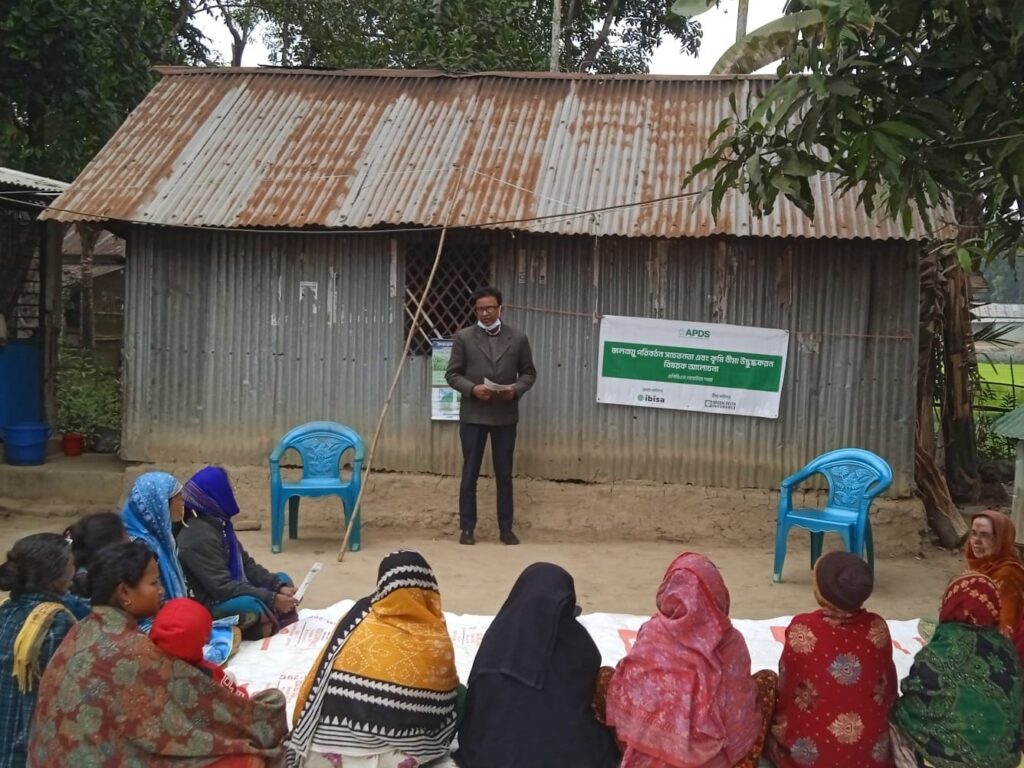
In Bangladesh, where climate risks are intensifying, Luxembourg-based insurtech company IBISA and the Association for Peoples Development Stream (APDS) – the microfinance entity of Friendship NGO – have joined forces to develop an innovative solution combining climate insurance and microcredit. Maria Mateo and Rokon Ashraful (respectively CEO and Project Manager at IBISA), together with Mohammad Mozammel Huq Ratan (CEO of APDS), share insights into this partnership. Supported by the Business Partnership Facility (BPF), this project illustrates how collaboration between the private sector and development actors can strengthen farmers’ resilience sustainably.

How does the partnership between APDS and IBISA address the challenges faced by Bangladeshi society?
Mohammad Mozammel Huq Ratan: In Bangladesh, a single extreme climate event can push a farmer into a debt cycle. Floods, heatwaves, and cyclones directly affect crops and therefore farmers’ incomes. As part of our mission to support development — particularly for farmers — APDS provides microcredit solutions. However, our users, who are mostly part of vulnerable populations, have very limited financial buffers. When a climate shock occurs, they quickly find themselves in difficulty due to crop and income losses, and their inability to repay loans.
Maria Mateo: Agriculture is a crucial but high-risk sector, especially in Bangladesh. Climate change amplifies this uncertainty, making financial institutions more reluctant to lend. Through this partnership, our goal is to reduce risks for both farmers and financial institutions by introducing parametric insurance solutions for climate events.
How does this solution work in practice?
Rokon Ashraful: IBISA proposes a parametric insurance solution linked to APDS loans. Payouts are automatically triggered when predefined climate thresholds, such as excessive temperatures or rainfall, for example, are reached . The model enables us to deploy coverage at scale while keeping premiums affordable. By distributing products through APDS loans, we can de-risk farmers’ income directly as they invest in their activities.
Maria Mateo: The objective is twofold: to protect farmers from climate shocks and to safeguard microfinance institutions, which play a key role in regional socio-economic development. When a major climatic event occurs, it rarely affects only one farmer – it affects hundreds. Insurance therefore becomes a key tool to stabilise microfinance institutions’ operations by reducing the risk of widespread default.
IBISA has already implemented similar projects, particularly in Africa. How did these experiences prepare you for Bangladesh?
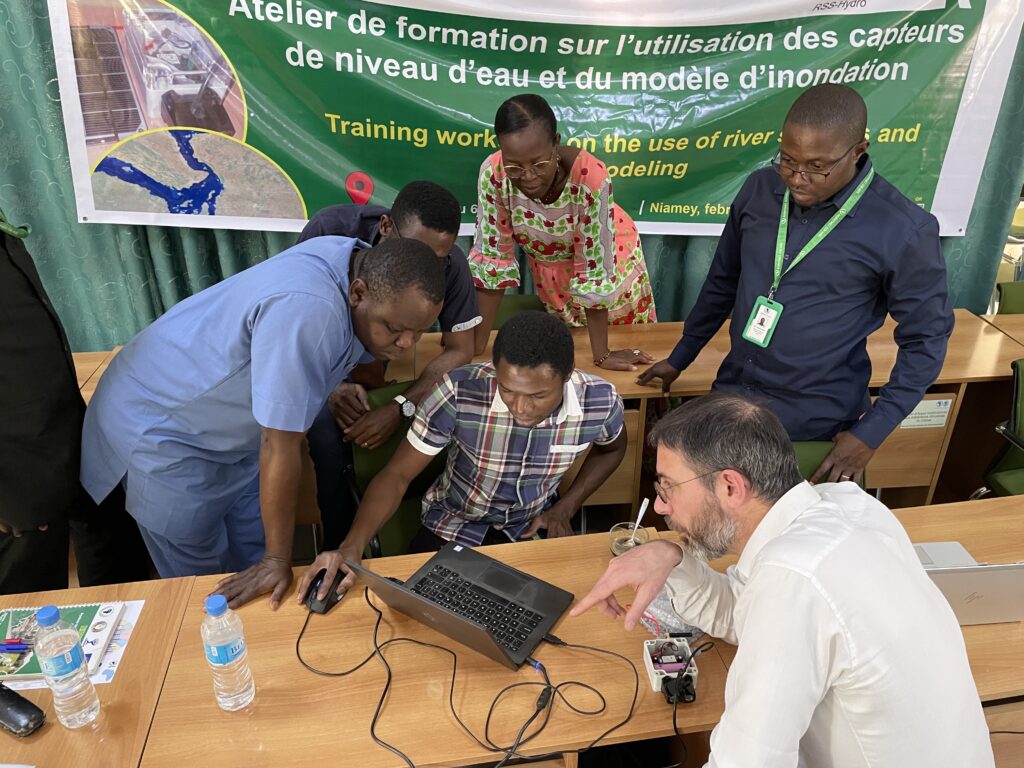
Maria Mateo: We tested our model in several African countries, starting with Niger, also with a first BPF support. These experiences helped us build strong foundations, especially in climate risk modelling and the design of parametric products.
However, each country is unique. In Bangladesh, we had to adapt our models to local realities – crop types, seasons, farmers’ behaviours. We don’t start from scratch, but significant adaptation work is always required. Our earlier experiences confirmed one key lesson: models can be transferred, but success depends on strong local adaptation.
How was the partnership between IBISA and APDS formed?
Maria Mateo: We were looking for a partner with strong local anchoring and a deep knowledge of their clients. I had already worked with Friendship – an NGO with strong links in Luxembourg – in my past professional experiences. APDS, as a microfinance institution under Friendship, already had a reliable network and a trusted relationship with communities.
Rokon Ashraful: Our partnership allows us to implement solutions tailored to the Bangladeshi context. We bring risk-assessment methodology and product design. APDS brings field expertise and acts as the key distribution channel.
Mohammad Mozammel Huq Ratan: For us, this collaboration is an opportunity to expand our services. We already support clients through microcredit. Insurance strengthens our offer by protecting farmers against risks they cannot absorb alone.
How is the project implemented on the ground?
Mohammad Mozammel Huq Ratan: We have deployed the project across several regions through our branch network. Our teams play a crucial role in explaining the products, training users, and providing ongoing support. Another important aspect is adapting products to seasons and crops – for example, we have developed specific solutions for rice and maize based on the risks of each period.
What are the main challenges of the project?
Mohammad Mozammel Huq Ratan: A major challenge is understanding the product. Unlike microcredit, where clients immediately receive funds, insurance requires paying a premium without guaranteed return if no climate event happens. This requires extensive awareness-raising through information sessions, educational materials, and long-term support to clients.
Maria Mateo: This is a universal challenge, but even more pronounced in contexts where insurance is new. Trust must be built gradually, and users need time to understand the value and benefits of these products.
The partnership started six months ago. Where do you stand today?
Mohammad Mozammel Huq Ratan: 6 months after the beginning of the BPF project, nearly 4,800 farmers have been sensitised, and almost 2,300 have already subscribed to coverage—exceeding our initial targets. Interest is growing, and users are beginning to understand the value of insurance. So far, no payouts have been triggered because the predefined climate thresholds were not reached. This is positive, but it also means beneficiaries have not yet experienced the mechanism firsthand, which remains a key challenge for awareness.
Rokon Ashraful: We are also seeing a positive impact on APDS activities. The portfolio has grown by 14%, suggesting that insurance not only protects but may also enhance the institution’s attractiveness and growth.
How has BPF support been essential?
Maria Mateo: The BPF plays a critical role, especially during the early stages. Developing this type of solution requires significant investment—product design, training, awareness, partnership structuring. BPF co-funding allows us to scale testing and demonstrate the model’s relevance.
Rokon Ashraful: It is also a lever for expansion. Thanks to the BPF, we have deployed our solution in multiple countries. Each project helps us learn, refine our approach, and prepare for the next one.
What are the next steps?
Maria Mateo: We will continue developing new products tailored to different seasons and risks in Bangladesh. The goal is to refine the solution and maximise its impact, with a final target to insure 10,000 farmers, and to raise awareness of 20,000 people over the 2-years duration of the project. This initiative shows how essential the collaboration between the private sector and development actors is for addressing complex challenges such as climate change.
Mohammad Mozammel Huq Ratan: We aim to expand the number of beneficiaries and continue raising awareness within communities. Once users fully understand the system, they become ambassadors in their own networks. By combining our strengths, we can deliver concrete, sustainable solutions that benefit both institutions and the communities we serve.
Related articles
-
Business Partnership Facility
 Mar. 2024
Launch of the 11th edition of the Business Partnership Facility – A co-financing to foster innovative business partnerships in developing countries
The Luxembourg Development Cooperation kicks off the 11th edition of the Business Partnership Facility (BPF) with a new call for proposals, open to Luxembourgish and European companies. -
Business Partnership Facility
 Mar. 2024
Information webinar on the Business Partnership Facility – 4 April 2024
Explore new business horizons with the BPF. Join our webinar dedicated to European companies to learn how to benefit from co-financing of up to EUR 200,000 for innovative and impactful business partnerships in developing countries. Register now to find out more! -
Business Partnership Facility
 Mar. 2024
The BPF in the spotlight on Delano!
Dive into the journey of COCA, a Luxembourgish architectural firm supported by the BPF, and discover how they are revolutionizing construction in Ghana!