When insurance meets microfinance: a new approach to climate resilience

What happens when insurance innovation meets microfinance, with the right public‑private support?
This Paperjam article shows how Business Partnership Facility Luxembourg (BPF) backing helped unlock a solution that strengthens farmers’ resilience to climate risks while safeguarding the sustainability of microfinance institutions.
- Faster payouts after climate shocks
- Reduced vulnerability for farmers
- Stronger, more resilient local economies
A powerful example of how targeted co‑financing can amplify impact.
Full article below: https://en.paperjam.lu/article/when-insurance-meets-microfinance-a-new-approach-to-climate-resilience
In Bangladesh, IBISA and APDS are testing an innovative model to protect farmers against climate risks. This project illustrates how Luxembourg Development Cooperation, through the Business Partnership Facility (BPF), leverages private-sector expertise to drive sustainable innovations.
An integrated approach to climate risk and financial inclusion
In Bangladesh, where increasingly frequent climate hazards are undermining rural economies, Luxembourg-based company IBISA and APDS – the microfinance institution linked to the NGO Friendship Luxembourg – are exploring a new way to combine financial inclusion with climate-risk management. This partnership blends parametric insurance with microcredit to the resilience of both farmers and the institutions that finance them.
Reducing a structural risk
In a country highly exposed to floods, heatwaves, and cyclones, agriculture is both essential and extremely vulnerable. “A climate event can be enough to push a smallholder farmer into a debt cycle due to the loss of income it causes,” explains Mohammad Mozammel Huq Ratan, CEO of APDS.
This vulnerability extends to microfinance institutions whose stability depends on borrowers’ repayment capacity. “When a major event occurs, it doesn’t affect just one client, but hundreds,” recalls Maria Mateo, co-founder and CEO of IBISA.
Parametric insurance: an adapted response
To address this systemic risk, IBISA develops parametric insurance solutions that are automatically triggered when predefined climate thresholds are reached. Distributed through APDS loans, these products provide farmers with coverage precisely when they invest in their activities. “The objective is twofold: to protect farmers, but also to secure the microfinance institutions that support them,” explains Maria Mateo.
This approach enables large-scale coverage while keeping premiums affordable for low-income populations.
A model built on complementarity
This project reflects the partnership-driven approach championed by the Business Partnership Facility (BPF)*: bringing together a European company and a local actor to co-develop innovative solutions tailored to local realities.
IBISA contributes expertise in risk modelling and insurance product design, while APDS brings deep field knowledge and close ties with communities. “We bring the methodology, but local anchoring is essential for the solution to work,” notes Rokon Ashraful, Project Manager at IBISA in Bangladesh.
For APDS, the collaboration strengthens its offer. “We already support our clients through microcredit. Insurance extends this support by protecting them against risks they cannot absorb on their own,” adds Mohammad Mozammel Huq Ratan.
The BPF: a key enabler
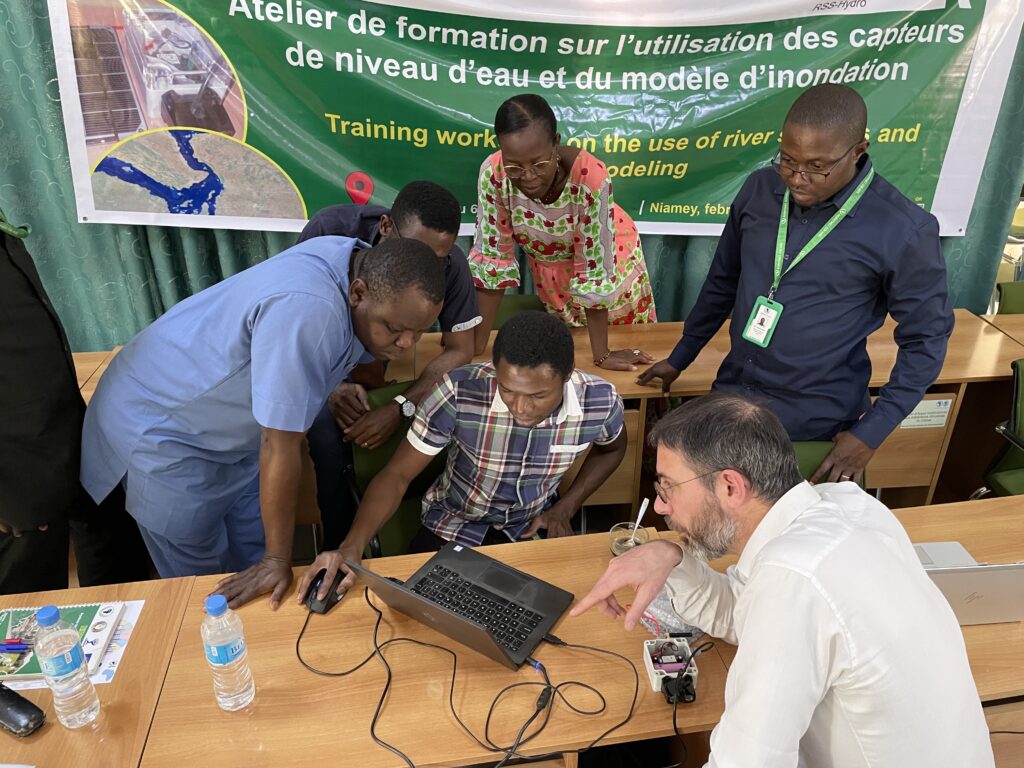
This initiative in Bangladesh is part of a broader journey for IBISA, which has previously tested similar solutions in Africa – notably in Niger, with a first BPF support. “The BPF plays a decisive role. By co-financing the early phases – design, training, awareness-raising – it enables us to test innovative models in complex environments,” explains Maria Mateo.
Encouraging early results
Six months after its launch, the project is already delivering tangible results: nearly 4,800 farmers have been reached through awareness activities, and around 2,300 have subscribed to coverage – exceeding initial targets. Over its two-year duration, the project aims to insure 10,000 farmers and raise awareness of 20,000 people.
By combining technological innovation, strong local anchoring, and public support, the BPF enables such initiatives that bridge development cooperation and entrepreneurship – generating both social impact and economic viability.
Apply to the 15th BPF call for proposals
The 15th BPF call for proposals is currently open. Entities wishing to partner – like IBISA and APDS (Friendship Luxembourg) – to develop business projects addressing sustainable development challenges can submit their proposals until May 8.
More information: https://www.luxaidbusiness4impact.lu/bpf or bpf@luxdev.lu
* The BPF is funded by the Ministry of Foreign and European Affairs, Defence, Development Cooperation and Foreign Trade, and implemented by LuxDev, the Luxembourg Development Cooperation Agency, in partnership with the Ministry of the Economy, the Chamber of Commerce and Luxinnovation.
Related articles
-
Business Partnership Facility
 Mar. 2024
Launch of the 11th edition of the Business Partnership Facility – A co-financing to foster innovative business partnerships in developing countries
The Luxembourg Development Cooperation kicks off the 11th edition of the Business Partnership Facility (BPF) with a new call for proposals, open to Luxembourgish and European companies. -
Business Partnership Facility
 Mar. 2024
Information webinar on the Business Partnership Facility – 4 April 2024
Explore new business horizons with the BPF. Join our webinar dedicated to European companies to learn how to benefit from co-financing of up to EUR 200,000 for innovative and impactful business partnerships in developing countries. Register now to find out more! -
Business Partnership Facility
 Mar. 2024
The BPF in the spotlight on Delano!
Dive into the journey of COCA, a Luxembourgish architectural firm supported by the BPF, and discover how they are revolutionizing construction in Ghana!